

Via Ferrata Santner Dolomites
A Guided Climb Through the History of Alpine Mountaineering
The Via Ferrata Santner is far more than one of the most beautiful via ferratas in the Dolomites.
Long before steel cables transformed it into today’s protected climbing route, this spectacular line was one of the great pioneering ascents of the nineteenth century. Every ledge, chimney and gully tells the story of the men who explored these mountains with little more than hemp ropes, handmade iron pitons and extraordinary determination.

Join an IFMGA/UIAGM Mountain Guide and experience the Via Ferrata Santner as few visitors ever do. Climb one of the most historic routes in the Rosengarten (Catinaccio) massif, spend the night at the spectacular new Santner Mountain Hut, and enjoy an unforgettable journey through the birthplace of Dolomite mountaineering.
This is not simply another via ferrata.
It is a journey back to the golden age of Alpine exploration.
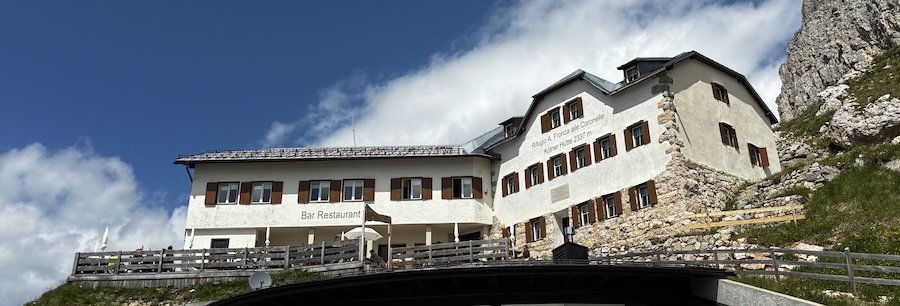
The starting point: RIFUGIO FRONZA ALLE CORONELLE – KOHLNERHUETTE
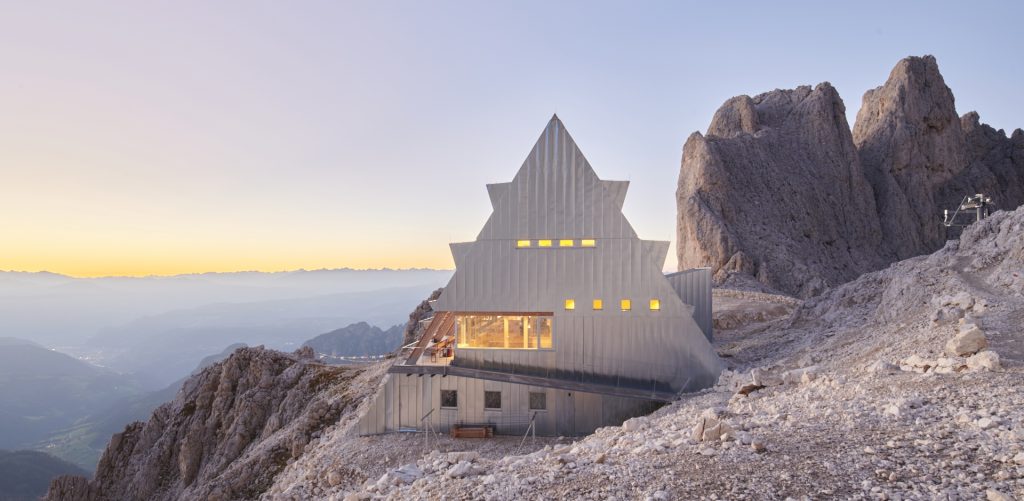
The arrival point: RIFUGIO SANTNER – SANTNERHUETTE
Why Choose Our Guided Via Ferrata Santner Tour?
Unlike many classic via ferratas, the Santner route offers much more than technical climbing.
It combines breathtaking scenery, fascinating mountaineering history and one of the most prestigious mountain huts in the Dolomites into a unique two-day experience.
Our most popular option allows you to:
- climb the Via Ferrata Santner accompanied by an experienced IFMGA Mountain Guide;
- learn the remarkable history behind this legendary route while climbing it;
- spend the evening at the spectacular new Santner Mountain Hut;
- descend independently (only if you are an experienced hiker) the following day after breakfast, enjoying one of several beautiful hiking routes through the Rosengarten.
This formula is becoming increasingly popular among international visitors looking for a premium Dolomite experience rather than simply completing another via ferrata.


AN IMPORTANT AND FUNNY SUGGESTION
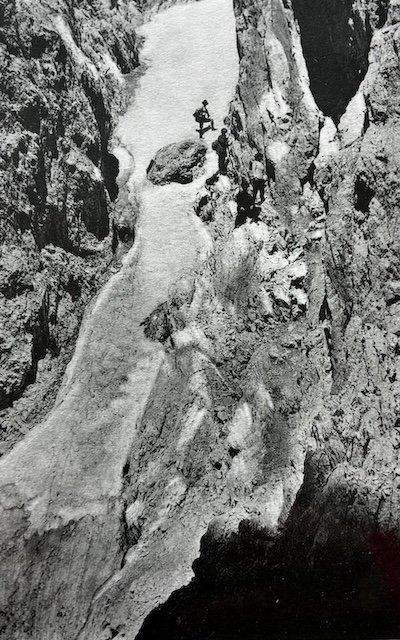
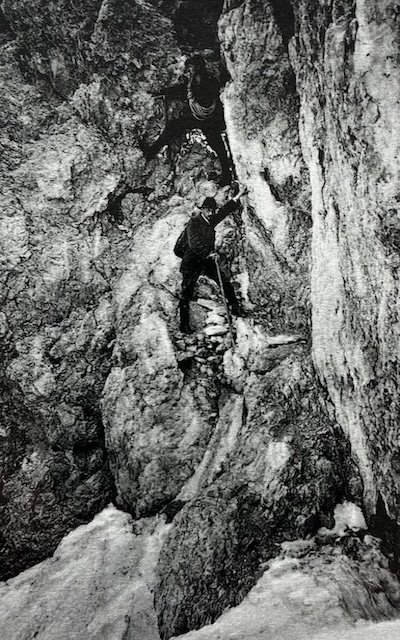
These two photos were taken about 200 meters to the right of the Santner Refuge, click to watch the exact allocation in Google Maps and then, when you will be here, downoad in your phone the historical picture on the left and go to take YOUR photo!
The Via Ferrata Santner: Where History Meets Adventure
Every famous mountain route has a story.
Few, however, possess the historical importance of the Via Ferrata Santner.
Today, climbers safely follow a modern steel cable through the steep western walls below Santner Pass. Yet the original route was not designed as a via ferrata at all.
It was first climbed in 1878 as a genuine alpine ascent during the heroic age of Dolomite exploration.
To appreciate this route fully, it is worth travelling back almost 150 years.

The Golden Age of Dolomite Exploration
During the second half of the nineteenth century, the Dolomites became the new frontier of European mountaineering.
Many of the highest summits in the Mont Blanc and Monte Rosa regions had already been climbed, prompting pioneers alpinists to seek fresh challenges elsewhere.Their attention turned towards the dramatic limestone towers of the Dolomites.Among these early explorers were numerous British gentlemen—wealthy travellers who had already gained considerable experience in the Western Alps. Accompanied by local mountain guides, they pioneered many of the great classic climbs that remain famous today.
Every summer brought new expeditions.Every valley concealed unclimbed peaks.Every mountain promised discoveries.The Rosengarten (Catinaccio) massif rapidly became one of the principal theatres of this extraordinary period of exploration.

Johann Santner: The Man Behind the Legend
While many pioneering ascents were driven by visiting British climbers, Johann Santner represented something different.
Born in 1840 in Defereggen, Tyrol, and later living in Bolzano until his death in 1912, Santner became one of the most influential local pioneers in the history of the Dolomites.
His life perfectly reflects the spirit of nineteenth-century Alpine exploration.
He first worked as a watchmaker before developing a passion for collecting alpine flowers. This occupation required him to venture into increasingly remote mountain terrain, where his remarkable knowledge of the landscape gradually evolved into exceptional mountaineering skill.
From these humble beginnings, Johann Santner opened approximately fifty new climbing routes throughout the Dolomites.
Among his greatest achievements were the first solo ascent of the peak now known as Santnerspitze, considered almost impossible at the time, and the first ascent of the striking Fünffingerspitze together with Robert Hans Schmitt in 1890—an expedition regarded as one of the hardest climbs ever completed in the Eastern Alps during that era.
Unlike many climbers of his generation, Santner frequently climbed alone.
He also introduced his wife and daughter Toni to the mountains, making them among the earliest women known to practise technical climbing in the Dolomites.
Johann Santner’s legacy extends far beyond first ascents.
He played a decisive role in transforming the Rosengarten and Schlern regions from isolated mountain landscapes known mainly to local shepherds into internationally recognised destinations for mountaineers and hikers.
His vision helped shape the future of Alpine tourism.
Thanks largely to his initiative, several important mountain huts were constructed, including the Schlernhaus (Rifugio Bolzano) in 1885, the Grasleitenhütte (Rifugio Bergamo) in 1887 and the first mountain shelter on Sella Pass.
Today, thousands of hikers unknowingly benefit from the infrastructure that Santner helped create over a century ago.
For this reason, climbing the Via Ferrata Santner is not merely a sporting achievement.
It is an opportunity to follow the footsteps of one of the founding figures of Dolomite mountaineering.

The First Ascent of Santner Pass (1878)
On 18 July 1878, Johann Santner completed what would become one of the most important pioneering ascents in the history of the Rosengarten (Catinaccio) massif.
Historical sources agree on the date of the ascent, although the exact composition of Santner’s climbing party remains uncertain.
What is certain is that this route would eventually evolve into today’s Via Ferrata Santner, one of the most celebrated via ferratas in the Dolomites.
Standing today in front of the western face of the Rosengarten, near the Kölner Hütte (Rifugio Fronza alle Coronelle), it is still possible to recognise the natural line that must have attracted Santner’s attention nearly 150 years ago.
An observant eye immediately notices a remarkable system of diagonal ledges and ramps crossing the steep limestone wall from right to left.
Unlike the surrounding vertical cliffs, these terraces appear almost inviting.
Even today, they seem to suggest a possible passage through an otherwise formidable mountain barrier.
It is difficult to imagine that Santner could have overlooked such an obvious natural weakness.


Reading the Mountain
For nineteenth-century mountaineers, climbing was very different from modern rock climbing.
No photographs.
No GPS tracks.
No previous reports.
Success depended almost entirely on the ability to “read” a mountain.
Every ledge, corner, crack and snow gully had to be interpreted from below.
The mountain itself provided the only clues.
Johann Santner possessed an extraordinary talent for this kind of observation.
Years spent exploring remote alpine terrain while collecting rare mountain flowers had trained him to recognise subtle features that others might never notice.
The long system of ramps leading across the west face was exactly the sort of terrain an experienced pioneer would investigate.


The Forgotten First Attempt
Although no detailed written account survives, historians generally believe that Santner attempted the route during the previous summer before eventually succeeding in 1878.
The first exploration probably followed the obvious diagonal ramps without great difficulty.
The real problems began higher up.
Upon reaching the area of isolated rock towers and pinnacles halfway across the face, the climbers likely searched for a way around these obstacles in the hope of reaching the large snow-filled couloir leading towards Santner Pass.
Instead, they encountered steep rock barriers that proved impossible to overcome with the equipment available at the time.
Turning back was probably the only sensible option.
Rather than a failure, however, this reconnaissance provided invaluable knowledge.Santner had discovered where not to go.


Climbing Before Modern Equipment
To understand the significance of this ascent, it is important to appreciate the equipment available to climbers during the 1870s.
Compared with modern via ferrata gear, the difference is astonishing.
A typical climbing party carried little more than:
a heavy hemp rope, usually around 30 metres long;
a small number of long hand-forged iron pitons, often over 20 centimetres in length;
a few short lengths of cord used to connect the rope to the pitons;
a shortened carpenter’s hammer for driving pitons into cracks.
And what about carabiners?
They had not yet been invented!
Every manoeuvre required tying and untying knots directly into the rope.
Progress was slow. Protection was minimal.
Every difficult move carried real consequences.
Footwear offered little advantage either.
Climbers wore heavy leather boots fitted with rows of forged iron hobnails designed primarily for walking rather than climbing.
When confronted with steeper rock, many nineteenth-century mountaineers adopted a solution that would surprise modern climbers: they simply removed their boots!
Bare feet often provided better friction on smooth limestone than the rigid hobnailed soles of the period.
Seen from today’s perspective, these methods may appear almost unbelievable.
Yet they were entirely normal during the heroic age of Alpine exploration.

Finding the Hidden Passage
The unsuccessful reconnaissance of the previous year proved decisive.
When Santner returned in the summer of 1878, he already understood that the obvious line was not the correct one.
After quickly traversing the familiar diagonal ramps, he abandoned the previous attempt to bypass the rock pinnacles from the outside.
Instead, he explored a more intricate line through hidden internal gullies and narrow passages between the towers.
This subtle change of route opened access to the great snow couloir rising directly towards Santner Pass.
Once inside the couloir, the climbing became considerably easier.
Historical evidence suggests that Santner probably used crampons and an ice axe to ascend the steep snow slopes to the pass.
Whether every detail unfolded exactly this way can no longer be known.
But the mountain itself still tells the story.
Anyone climbing the Via Ferrata Santner today can clearly appreciate the remarkable intuition that enabled Santner to discover this elegant natural line through such imposing terrain.
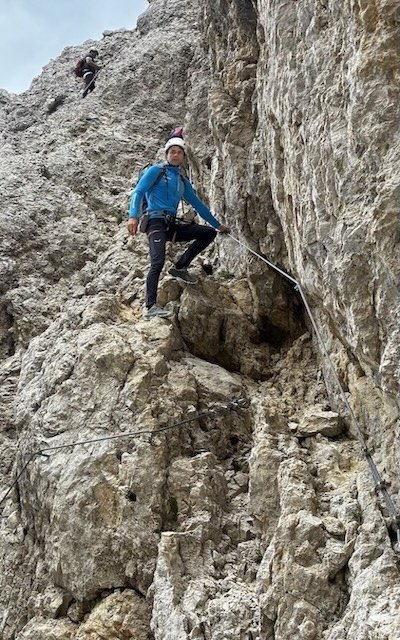
From Historic Climb to Modern Via Ferrata
The route followed by today’s Via Ferrata Santner is not identical to Santner’s original ascent.
After the snow couloir, the modern protected route traverses the left-hand rock walls before reaching Santner Pass.
Historical photographs suggest that this variation developed during the early twentieth century, when increasing numbers of climbers began visiting the Rosengarten.
Many of the remarkable historical photographs displayed on this page date from that fascinating period.
Comparing them with modern images reveals how little the mountain itself has changed.
During the 1950s and 1960s, the first steel safety cables were installed along the most exposed sections.
Over the decades, these cables have been upgraded several times, creating the modern Via Ferrata Santner enjoyed by thousands of climbers each summer.
Yet despite these improvements, the route has never lost its original character.
Much of today’s experience still follows the natural line first recognised by Johann Santner almost a century and a half ago.


Where History Ends, Legend Begins
Every famous mountain has its legends.
The Via Ferrata Santner is no exception.
One of the most frequently repeated stories suggests that the route had already been used by local chamois hunters long before Johann Santner’s ascent in 1878.
It is an attractive story.
Unfortunately, historical and practical evidence makes it highly unlikely.
Could Chamois Hunters Have Climbed This Route?
To answer this question, we need to understand how hunting was actually practised in the nineteenth century.
Until well beyond the middle of the 1800s, hunters generally relied on smoothbore muzzle-loading firearms.
These weapons lacked the accuracy of modern rifles.
To ensure a successful shot, hunters needed to approach remarkably close to their prey—often within less than one hundred metres.
This limitation shaped the entire hunting strategy.
Rather than following animals across exposed mountain walls, hunters attempted to drive groups of chamois into enclosed gullies, steep basins or natural traps where escape became difficult.
Only then could they approach close enough for an effective shot.
Viewed from this perspective, the natural ramps crossed by today’s Via Ferrata Santner make little sense as a hunting route.
The ledges climb steadily across an open cliff without enclosing animals or creating favourable shooting positions.
Even if a hunter had succeeded in shooting a chamois in such terrain, recovering the animal and carrying it safely back into the valley would have been extraordinarily difficult.
The route simply does not match the practical requirements of traditional mountain hunting.
There is an even stronger argument.
The upper part of Santner’s original ascent involved difficulties that extended far beyond ordinary mountain travel.
After traversing the rock ramps, the route required negotiating steep rocky terrain before entering a large snow-filled couloir leading directly towards Santner Pass.
During much of the climbing season, this couloir demanded the use of crampons and an ice axe.
These are mountaineering techniques. Not hunting techniques.
Local hunters were undoubtedly exceptional mountain men. Their knowledge of the terrain remains legendary.
Yet the technical climbing involved on this ascent appears to have exceeded what would normally have been required—or justified—for hunting chamois.
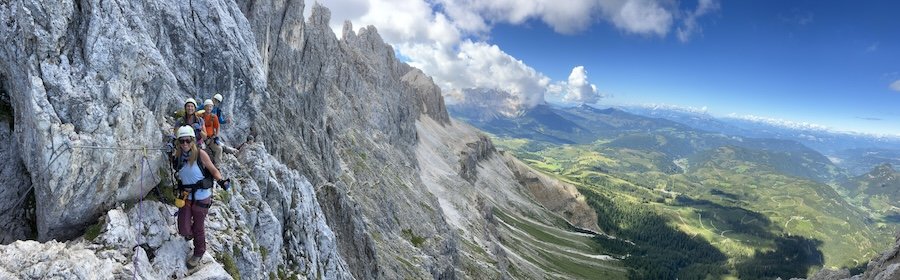


What Makes Santner’s Achievement So Remarkable
Whether or not anyone had previously ventured onto isolated sections of the mountain is ultimately impossible to prove.
History rarely offers absolute certainty.
What is beyond dispute is that Johann Santner recognised the mountain as a complete route, understood how its different natural features connected together and successfully climbed them to reach Santner Pass.
That required far more than courage.
It demanded imagination.
Observation.
Experience.
And an extraordinary ability to read the landscape.
These qualities explain why Santner remains one of the founding figures of Dolomite mountaineering.
When climbing the Via Ferrata Santner today, it is worth remembering that the steel cable is a modern addition.
The true achievement belongs to the man who first looked at this immense limestone wall and saw, where others saw only cliffs, a possible way through.


The Via Ferrata Santner Today
Although more than 140 years have passed since Johann Santner’s pioneering ascent, the mountain has preserved its original atmosphere.
The same towers dominate the skyline.
The same diagonal ramps cross the western wall.
The same dramatic gateway leads towards Santner Pass.
What has changed is the level of safety.
Modern steel cables now protect the most exposed sections, allowing experienced hikers with proper equipment to enjoy one of the most spectacular historic routes in the Dolomites.
Yet the climb still demands respect.
It requires good fitness, confidence on exposed terrain and careful route management.
For many visitors, climbing with an experienced IFMGA Mountain Guide transforms the experience.
Beyond providing safety, a local guide explains the history of the mountain, the geology of the Rosengarten, the evolution of Alpine climbing and the remarkable story of Johann Santner himself.
The result is far more than a sporting achievement.
It becomes a journey through the history of the Dolomites.
More Than a Via Ferrata
The Via Ferrata Santner is not simply another protected climbing route in the Dolomites.
It is a journey through nearly one hundred and fifty years of Alpine history.
Every ledge crossed today was once explored without steel cables.
Every chimney tells the story of the pioneers who ventured into these mountains with little more than courage, experience and an extraordinary ability to read the landscape.
Johann Santner did not create a via ferrata.
He discovered a natural passage through one of the most impressive limestone walls in the Rosengarten, opening a route that would later become one of the classics of the Dolomites.
Climbing this route today means following the same line first recognised by one of the great pioneers of Alpine mountaineering.
For those willing to slow down and look beyond the cables, the Via Ferrata Santner offers something increasingly rare.
It allows you to experience not only a mountain, but also the history that shaped it.
Following the Footsteps of the Pioneers
For many years I have guided climbers along the Via Ferrata Santner.
The more time I spend on this remarkable route, the more I appreciate that its greatest value is not only the spectacular scenery, but also its extraordinary history.
At Rifugio Fronza I have collected rare historical photographs of the original ascent route and returned to the mountain to recreate each image from exactly the same viewpoint.
The comparisons you have seen on this page reveal something remarkable.
Although modern equipment has made the climb safer, the mountain itself has changed very little.
The towers. The ledges. The skyline.
The landscape that Johann Santner explored almost one hundred and fifty years ago is still here, waiting to be experienced.
Sharing this story with my guests has become one of the most rewarding parts of guiding.
My goal is not simply to lead clients safely to Santner Pass.
It is to help them understand why this route occupies such a special place in the history of the Dolomites.
Join Us on the Via Ferrata Santner
Whether you are an experienced via ferrata climber or looking for a memorable guided adventure in the Dolomites, the Via Ferrata Santner offers an experience unlike any other.
Climb one of the most historic routes in the Alps with an IFMGA/UIAGM Mountain Guide.
Discover the fascinating story of Johann Santner and the birth of Dolomite mountaineering.
Spend the night at the spectacular new Santner Mountain Hut.
And return home having experienced not just another via ferrata, but one of the true classics of Alpine history.We look forward to sharing this unforgettable journey with you!
Ready to Experience the Via Ferrata Santner?
If you would like to climb one of the most historic via ferratas in the Dolomites with an experienced IFMGA/UIAGM Mountain Guide, simply complete the booking form below. We will be happy to answer your questions and help you plan an unforgettable adventure.

CONTACT ME
"*" indicates required fields
Frequently Asked Questions
Via Ferrata Santner short basic info
- Walking to the approach: 0.40 hrs
- Climbing the Via Ferrata in: 2.30 hrs
- Total time of this day: 6.10 hrs
- Total vertical gain (up): 751 m.
Do I need previous via ferrata experience?
The Via Ferrata Santner is considered an intermediate to demanding route. Previous via ferrata experience is recommended, together with good physical fitness and confidence on exposed terrain. If you are unsure whether the route is suitable for you, we will be happy to advise you before booking.
When is the best time to climb the Via Ferrata Santner?
The ideal season normally extends from late June until early October.
Earlier in the season, the upper snow gully may still be filled with steep snow. During this period the steel cable may remain buried beneath the snowpack, requiring the use of crampons, an ice axe and short-rope techniques. Only these conditions are suitable only for experienced mountaineers and very small guided groups. For the rest of the summer season it’s ok for every hiker.
Can I stay overnight at Santner Mountain Hut?
Yes. Many guests choose to climb the Via Ferrata Santner with us, spend the night at the spectacular new Santner Mountain Hut and descend independently the following morning after breakfast. This has become one of the most appreciated two-day experiences in the Rosengarten (Catinaccio) massif.
What equipment is included?
Your guide provides all essential technical equipment:
– Climbing harness
– Via ferrata lanyard
– Via ferrata gloves
– Helmet
Participants only need suitable mountain clothing, hiking boots, personal backpack with food and water.
How far in advance should I book?
The Via Ferrata Santner is one of the most sought-after guided climbs in the Dolomites, especially during July, August and September. We strongly recommend booking as early as possible to secure your preferred date.

About the Author
Roberto Iacopelli is an IFMGA/UIAGM Mountain Guide based in the heart of the Dolomites. For many years he has guided climbers on the Via Ferrata Santner while researching its history through historical photographs, early mountaineering accounts and repeated field observations. His goal is to combine safe guiding with a deeper understanding of one of the most significant historic climbing routes in the Dolomites. During my years of guiding on the Via Ferrata Santner I have climbed this route in a wide variety of conditions, from early summer snow to the warm days of late September. Every ascent reveals new historical details that continue to fascinate me.

Best Via Ferratas of the Dolomites: the most extended program
 If you are looking to climb the best via ferratas of the Dolomites with a flexible and customised program that can give you the most extended overview, this is the best solution to explore the Dolomite mountains really at 360°.
Via Ferrata Dolomites: customised hut to hut treks in the Central Dolomites
 This proposal is in absolute the most flexible and complete via ferrata trekking in the Dolomites! Flexible because you can choose from 2 to 10 days of via ferrata trekking. Complete because you will cross with via ferratas all the central territory of the Dolomites.
Via delle Bocchette: modular trekking in Brenta Dolomites
 The via ferrata trekking in the western Dolomites is a unique experience along the famous Via delle Bocchette. A concatenation of many via ferratas on the main crest of the Brenta Dolomites.
Via Ferrata Cortina: your modular program for via ferrata in the Dolomites
 Via Ferrata Cortina is a multi-day modular program around the amazing and famous Cortina d’Ampezzo area, part of the eastern Dolomites. Via Ferrata Cortina combine a large range of via ferratas: from easy and short perfect for beginners to extreme long and difficult for expert and trained hikers.
Via Ferrata in the Southern Dolomites: hut to hut in the Pale di San Martino
 The southern Dolomites are the more extended area of the Dolomites, with many via ferrata long and complicated. We can traverse these Dolomites with the "great via ferrata concatenation of the Pale di San Martino"
The longest via Ferrata of the Dolomites: The Great Civetta Traverse
 The longest Via Ferrata of the Dolomites is absolutely the “Via Ferrata Costantini” at the Mojazza peak, and the most impressive (only a bit shorter) is some kilometres north: the “Via Ferrata degli Alleghesi” at the Civetta Peak. With this hard tour we will climb both!
Via Ferrata in autumn, winter, or spring: Arco and Garda Lake area
 A via ferrata weekend in winter is really possible, the program that you can read here, that I name “Via Ferrata Arco” and “Via Ferrata Garda Lake” is a realistic opportunity to try this fantastic experience of climbing in autumn, winter and spring.
Via Ferrata Lake Como: the best climbs of the lake Como
 The best proposal to combine a active holiday in the Lake of Como with the amazing outdoor activity of the via ferrata! Don't miss this opportunity to live a unique vertical experience.... ask for you custom program!
Via Ferrata Austria: the best via ferrata in Tyrol
 The variety of via ferratas in Austria makes the Via Ferrata Austria program an excellent modular solution to choose based on your vacation availability. From 3 to 5 days or more, you can explore the Tyrol region with the Via Ferrata Austria program, with a large selection from beginners to advanced hikers.
The Best Via Ferrata in Piedmont: An Unforgettable Week-Long Adventure
 Embark on a week-long via ferrata journey in Italy, and unlock a world of adventure, history, and breathtaking scenery. Here’s why this region stands out as the premier destination during the spring and autumn periods.
Via Ferrata for beginners: daily tours and personal programs
 If you are beginner on the reality of the via ferrata.... this is your program! I have thinked this proposal for hikers that are scared on the approach of via ferrata. Are you ready? Read it!
WW1 - World War One in the Dolomites: Via Ferrata and Trekking
 The front line of World War One (WW1) cut the Dolomites in diagonally. Along the ruins of the mountain front we can do adventurous hut to hut trekking and climbing via ferratas. These proposals are impressive for every person, from easy hikers to experienced climbers.


